
Mining Bitcoin with a Bitaxe, NerdQAxe or any other small ASIC? Then the payout model matters more than the hardware. SOLO mining is a lottery with odds measured in thousands of years – PPLNS turns the same hashrate into a share of every block your pool finds.
The problem: Bitcoin mining is a lottery
The Bitcoin network currently runs at roughly 1,090 EH/s and finds one block about every ten minutes (144 per day). Whoever finds a block collects the full block subsidy of 3.125 BTC plus the transaction fees. Your chance to be that miner is simply your hashrate divided by the network hashrate, once per block.
For a small machine that is a very small number:
Your hashrate | Typical device | Expected time to solo-mine one block* |
|---|---|---|
1 TH/s | Bitaxe Ultra / Supra class | about 20,000 years |
5 TH/s | NerdQAxe / Bitaxe Gamma cluster | about 4,000 years |
100 TH/s | used Antminer S19 class | about 200 years |
200 TH/s | Antminer S21 class | about 100 years |
*Average, assuming a network hashrate of about 1,090 EH/s. A block can come tomorrow – or never. That is exactly what “lottery” means.
SOLO mining is fun, it is fair, and every share you submit is a lottery ticket. But it is not income. If you want your machine to produce something you can plan with, you need to pool your hashrate.
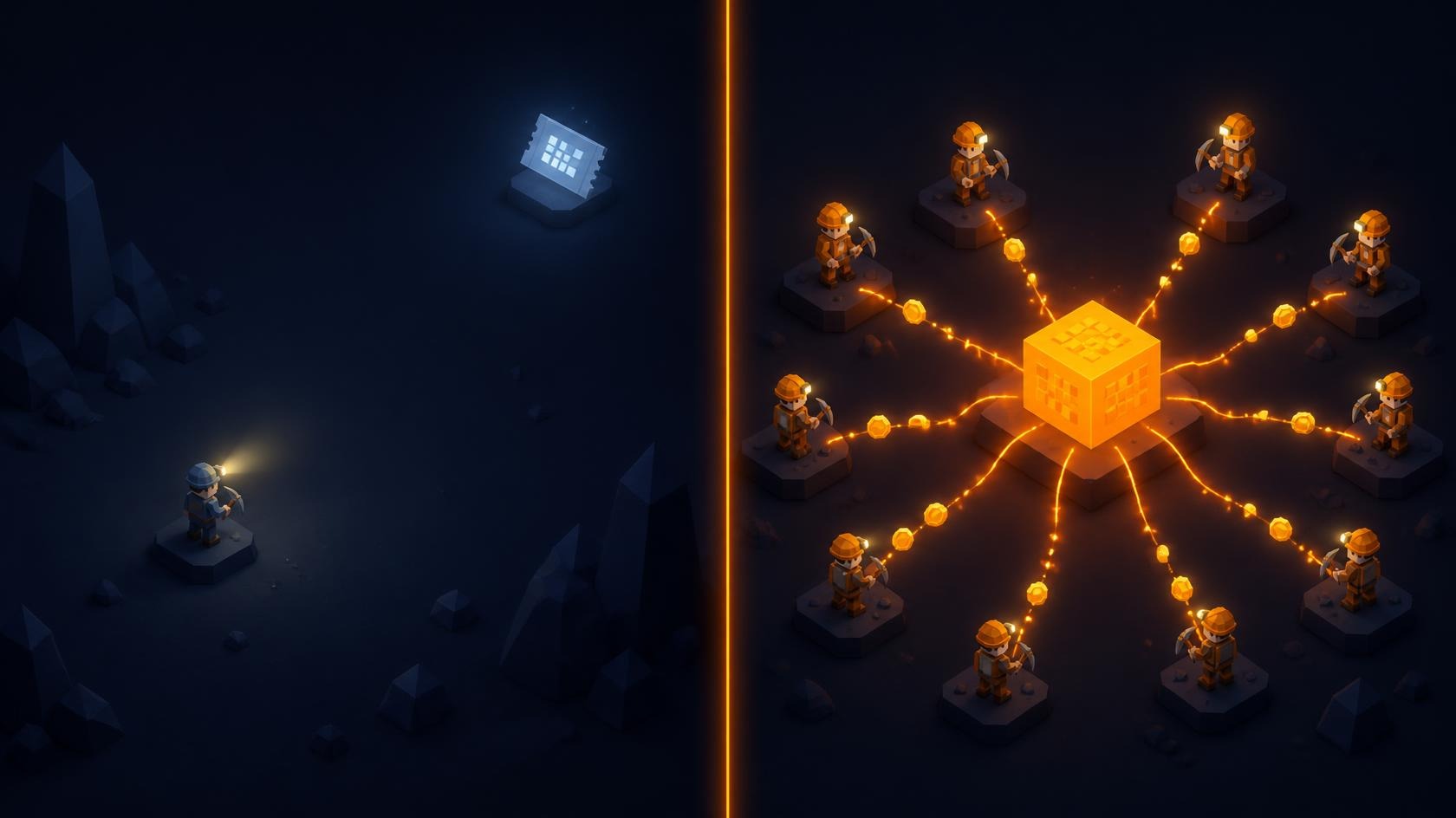
What PPLNS means
PPLNS stands for Pay Per Last N Shares. Every time your miner finds a share, the pool records it. When the pool finds a block, the reward is split among the miners who contributed shares in the most recent window of N shares – in proportion to the work each of them did. On onpool.net, N is two times the network difficulty.
- Your payout = your share of the window × block reward × (1 − pool fee).
- Rewards are credited when the block matures (100 confirmations, about 17 hours).
- Payments are sent automatically once your balance reaches the minimum payout.
- Miners who stay connected are rewarded; hopping in and out of a pool right before a block does not pay off, because the window looks back over your recent work.
Why PPLNS fits small machines
- You are paid for work, not for luck. Variance still exists, but it is shared by the whole pool instead of being carried by one tiny machine.
- Small contributions count. A 1 TH/s miner receives exactly the fraction its shares are worth – no minimum hashrate, no “too small to matter”.
- Predictable behaviour. Because the window is long, one lucky or unlucky block does not decide your month.
- Low barrier. The minimum payout on onpool.net is just 0.0005 BTC.
Honest numbers: pool size is what smooths the variance
PPLNS does not create hashrate out of thin air. How steady your income is depends on how often the pool finds blocks, and that depends on the pool’s share of the network. A pool with 1% of the network finds a block roughly every 17 hours; a pool with 0.001% needs more than two years.
The onpool.net PPLNS pool is still young and small, so blocks will not be frequent yet. We would rather tell you that than promise a paycheck. Every miner who joins makes block finds more frequent for everybody – the same effect that makes pools worth joining in the first place. If you want to be an early part of it, the technical side is simple.
Call your friends: more machines, steadier rewards
In PPLNS, a pool is only as strong as the machines behind it. Every miner who joins adds hashrate, and more hashrate means the pool finds blocks more often. That is the whole trick: your reward per block stays proportional to your work, but the blocks come sooner and the gaps between them shrink.
So do not mine alone in a corner. Ask your friends, family, colleagues or your local mining group to point their Bitaxe, NerdQAxe or ASIC at the same pool. Nobody has to set up a “group”: everyone simply connects with their own Bitcoin address and worker name, and everyone is paid for their own shares. A handful of small machines that would each wait thousands of years alone become part of one team that finds blocks together.
Here is what pool size means in practice (average time between pool blocks at a network hashrate of about 1,090 EH/s):
Total pool hashrate | Roughly one block every… |
|---|---|
7 TH/s (a few home machines) | about 3,000 years |
100 TH/s | about 200 years |
1 PH/s | about 20 years |
10 PH/s | about 2 years |
100 PH/s | about 75 days |
1 EH/s | about 7 days |
10 EH/s | about 18 hours |
The honest reading of this table: a group of friends alone will not turn into a salary. Steady, predictable income appears when a pool becomes large, and a pool becomes large one miner at a time. Every additional machine moves the whole pool one step down this table – and with PPLNS, every one of those steps benefits everybody who is connected.
Call your friends and acquaintances, work as a team on onpool.net, get closer to winning together – and share fairly, in proportion to the contribution each of you makes. Setting up takes two minutes: connection settings.
How to connect to the onpool.net PPLNS pool
Use these settings in your miner (Bitaxe, NerdQAxe, cgminer, BFGMiner, Antminer and others):
Stratum URL (works with every miner) | stratum+tcp://btc.onpool.net:3344 |
Stratum URL (TLS, optional – only if your miner supports SSL) | stratum+ssl://btc.onpool.net:3345 |
Username | your_bitcoin_address.worker_name |
Password | x |
Pool fee | 1.5% (PPLNS) – SOLO: 1% |
Minimum payout | 0.0005 BTC |
Difficulty is adjusted automatically (VarDiff), so you do not need to guess a value. Open the connection page for all ports and the getting started guide for step-by-step instructions. After a few minutes, enter your address on the miner stats page to see your hashrate and workers live.
Frequently asked questions
Is PPLNS better than SOLO for a Bitaxe?
If you want regular, proportional rewards: yes, that is what PPLNS is built for. If you accept long odds for a chance at the whole 3.125 BTC block, SOLO is still a legitimate choice – just do not expect it to pay.
Can I switch between SOLO and PPLNS?
Yes. They are separate ports on the same pool. Change the stratum URL in your miner and restart it; nothing else is needed.
Which difficulty should I set?
None. onpool.net adjusts it automatically to your hashrate. Fixed difficulties usually only make the hashrate display noisier.
How are PPLNS payouts calculated exactly?
Your share of the last N shares (N = 2 × network difficulty) times the block reward, minus the 1.5% pool fee. Payments are made automatically once a block has matured and your balance reaches 0.0005 BTC.
Do I need an account?
No. Your Bitcoin address is your account – use it as the username followed by a worker name.
Hashtags: #PPLNS #SoloMining #BitcoinMining #Bitaxe #NerdQAxe #MiningPool #HomeMining #BTC #SmallMiners #onpool

