Why Your Mining Rig Slows Down When Bitcoin Gets Busy (And How to Stop It);
f you've ever watched your miner's numbers dip for no obvious reason, you're not imagining it. There are moments — sometimes lasting minutes, sometimes hours — when the Bitcoin network itself gets crowded. Thousands of people are suddenly sending transactions at once: a price swing, a big NFT drop, a wave of exchange withdrawals. It happens more often than most miners realize.
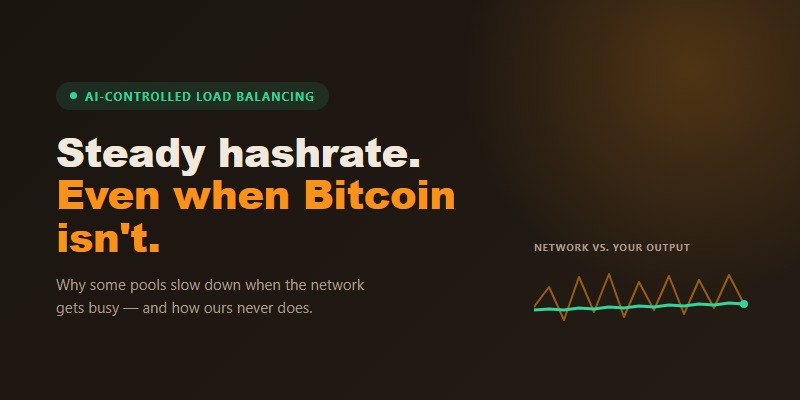
Here's the part almost nobody explains to you: most mining pools were never built to handle that moment well. When the network gets busy, the pool has to work harder behind the scenes to build your next block of work. If it's slow to react, your machine sits there a little less efficiently — and a little less efficiently, multiplied across thousands of blocks a year, adds up to real money left on the table. You never see an error message. You just quietly earn less than you should.
What we built instead
Our pool watches this happening in real time, every single second, and adjusts itself automatically — the moment the network gets busier, and the moment it calms back down. No engineer has to notice a problem and log in to fix it at 3am. There's nothing for you to configure, nothing to toggle, nothing to think about. You just plug in your stratum address like normal, and the system underneath does the rest.
We call this AI-controlled load balancing, and as far as we've been able to tell, we're the only pool doing it this way. It's not a marketing label we slapped on afterward — it's a piece of technology we spent months building, testing, and quietly running in production before we ever wrote a word about it publicly.
Why this matters more than people think
Think of it like a highway on-ramp with a smart traffic light. A dumb system either lets everyone in at once (a jam) or shuts the gate too early (wasted capacity). A smart system watches the actual traffic and adjusts the timing every few seconds, so the road stays as full and as fast as it can possibly be, no matter what's happening upstream.
That's exactly the difference between a pool that reacts to network congestion and one that doesn't. And it's the difference between hashrate that quietly leaks away during busy periods, and hashrate that keeps earning at full strength — all day, every day, whether Bitcoin is calm or chaotic.
The Era of Zero Loss in Mining: Why Does the Share Rejection Rate Matter?
In almost all traditional mining pools, the rejected share rate is around 2%. In addition to your electricity and depreciation costs, this represents an extra cost item that directly reduces your net income.
Thanks to our custom-developed AI optimization, we have brought this rejection rate strictly down to 0%.
Regardless of your device's size or hash power, our system operates in perfect harmony with Mempool requirements. Your hardware performs at full capacity with zero losses.
Experience the advantages of our platform for yourself and share your thoughts in the comments below!
You don't need to understand any of this to benefit from it
That's the whole point. You don't need to watch mempool charts, read block explorer data, or babysit your setup. You point your miner at us, and the pool handles the rest — automatically, continuously, without you lifting a finger. That's what "no sign-up, no KYC, just plug in and mine" is supposed to mean in practice: not just an easy start, but an easy everything, for as long as you keep mining with us.
If your current pool has ever felt inconsistent for reasons you couldn't explain, this is very likely why. Give ours a try — your hardware will feel the difference even if you never see the mechanism behind it.

